
After a horrific typhoon hits the coast of Japan, a giant egg is spotted out at sea. The local fishermen decide to sell it to a greedy businessman who wants to build a theme park around it. Then, two tiny fairies demand the return of the egg to their island, but the businessman refuses. A photographer, a scientist and a journalist try to help, but not before discovering something else that washed ashore during the typhoon!
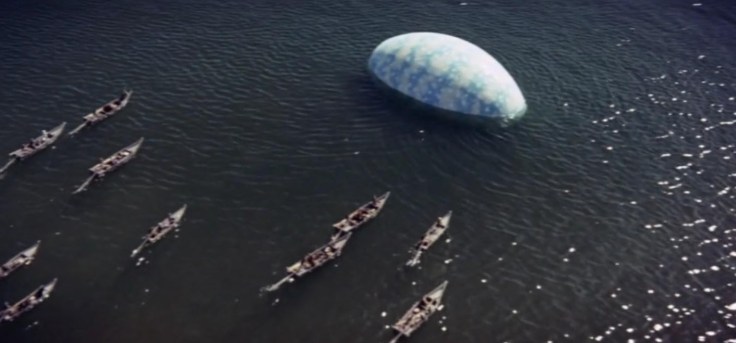
Released in 1964, and directed by Ishirô Honda; Mothra vs. Godzilla is the fourth film in the Godzilla series, and the first to feature both Mothra, and Mothra’s twin fairies, better known as the ‘Shobijin’. The film stars Akira Takarada, Yuriko Hoshi, and Hiroshi Koizumi; with Yû Fujiki, Kenji Sahara, Yoshifumi Tajima, Jun Tazaki, Yoshio Kosugi, and The Peanuts (Emi and Yumi Itô) in supporting roles. Interesting little fact: a few short shots from this film can be seen in the music video for the Iron Maiden song; The Number Of The Beast.
Mothra vs. Godzilla is the only the third time in the series where two monsters have fought each other. The other two instances of this are in the previous film King Kong vs. Godzilla, and Godzilla Raids Again. The pairing of these two monsters in this film came thanks to the success of both King Kong vs. Godzilla, as well as the original Mothra. According to early scripts written by Shin’ichi Sekizawa, The events of this film were meant to pick up directly from Mothra, but much of the script was later changed by Honda. As the film goes, there is no evidence of a direct link between it and Mothra 1961.
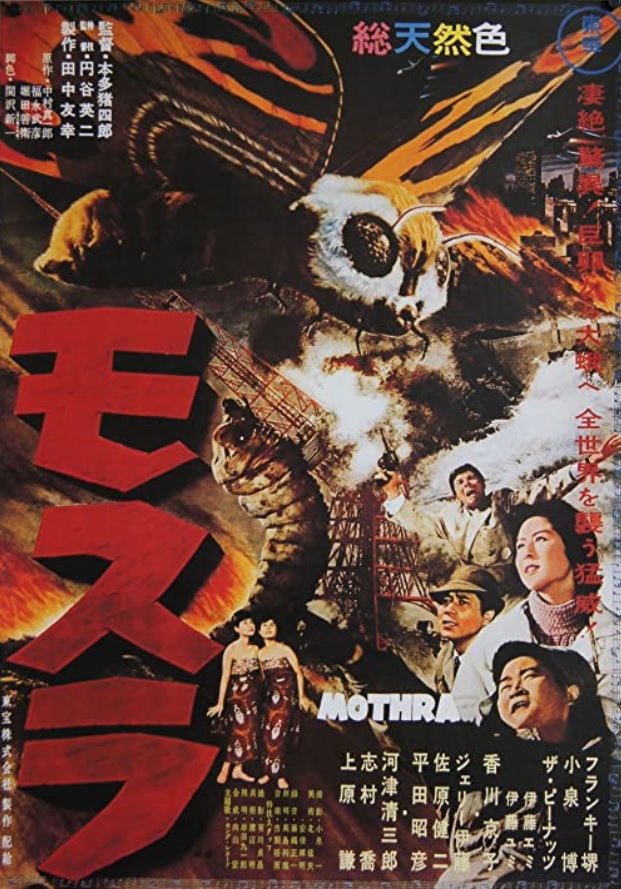
In addition to that, it’s also one of the few instances; where after it was picked up by an American Distributor, additional scenes were filmed and added, but only in the American release, where for some reason or another it was released as: “Godzilla vs. The Thing“!
Back to the original now. So, the story is about an egg being discovered by a greedy businessman, and a couple of fairies warning about the damage the creature inside could do once hatched. But as the businessman only wants ways to generate money, he refuses, so the fairies give up and go home. Soon after this though, Godzilla arrives, having been buried in mud all this time. He then goes on a the rampage, with the heroic leads heading off to Infant Island to try and get Mothra’s help. That’s pretty much the film in a nutshell.
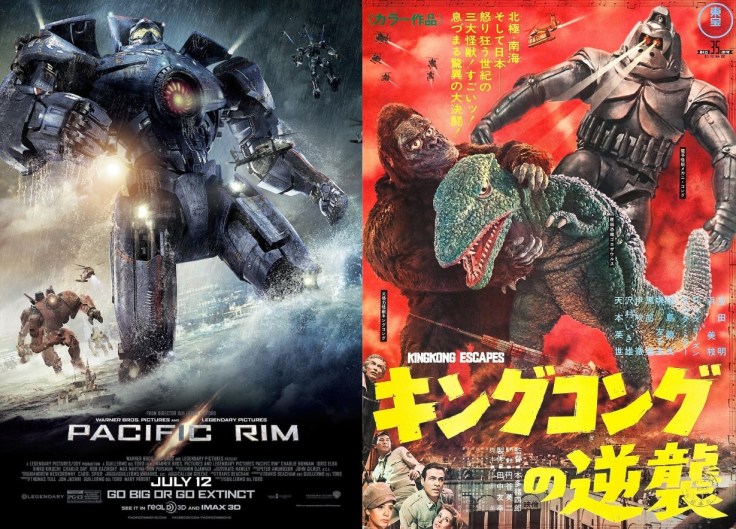
Mothra vs. Godzilla is highly and widely regarded as one of the series best films. Much like the original film, Ishiro Honda tries to send a message within it about corporate greed, and distrust in hummanity. To this end the film features Godzilla going on a long and unstoppable destructive path, taking several towns and cities with him. This then ideally set’s up the story for the heroes to ask for help from another monster, because what else can possibly stop Godzilla? I mean I suppose they could go Pacific Rim and build their own monster? But this was the 1964, and the events of King Kong Escapes was still three years away!
This in turn fuels the message of distrust, as the inhabitants of Infant Island don’t trust the humans, after they used their island as the testing ground for Hydrogen Bombs. It’s a nicely, but basically detailed story, where one thing occurs, and then another thing happens to reach the desired end goal.

It is a terrific film, but it does have some annoying little niggles. Firstly there’s the moment where the team arrives on Infant Island, and a supposedly dead fossil, is shaking it’s head, repeatedly. On that point too, why is it that the team, knowing full well that the island was used as a nuclear weapon testing site, turn up wearing a summer dress, and formal business attire? I can understand you wanting to make a good impression on a diplomatic mission, but why not at least wear something more realistically practical? Also, how does a newspaper editor have the power and authority to request a military seaplane to take these untrained, unmilitary types, to a nuclear testing site?

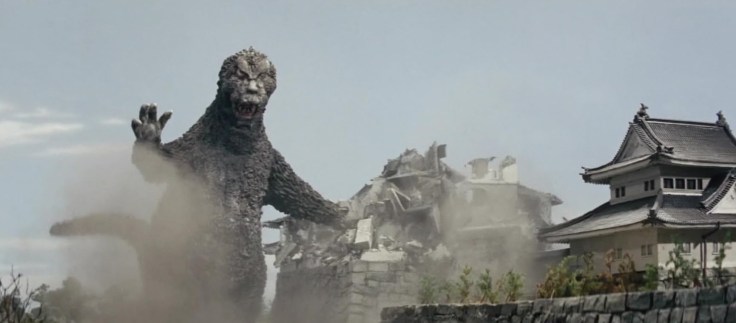
Godzilla’s destruction, whilst entertaining, is also not entirely perfect either. His attack on Nagoya allows the audience to see one of Japan’s most beautiful sites: Nagoya Castle. But When Godzilla shows up, he destroys it, in a rather unconvincing way. He smashes through it quite easily with his hands, but the building is somehow still strong enough to take his entire weight, when he falls onto it? And then there’s all the strange angled shots of Godzilla’s head to!

These niggles, are noticeable, but thankfully few, as the film contains some moments that you don’t want to miss. The first fight between the two titular monsters is fast, brutal, and at a good length to enjoy the switching of advantages. Much like Godzilla Raids Again, in that it looks like two monsters desperately trying to genuinely kill each other.
Then there’s the two epic battles between the Military and Godzilla. You see these wonderfully crafted shots of tanks sneaking up behind Godzilla, with assistance from choppers and fighters, and terrific effects, showing what is quite possibly, the closest the Japanese Self Defense Forces have come to actually defeating Godzilla. They even set fire to his head, like that fireball headshot in Shin Godzilla 52 years later. And all the while, these battles are backed up by an incredibly unique soundtrack!
Many films in the series do have pieces of soundtrack written for that film, but at the same time, they also often use other pieces from other films. This though is one of those cases where the soundtrack actually feels unique, as when you ponder the score, you immediately recognize which film it belongs too.
Composed by series regular Akira Ifukube, the film features many unique, and epic pieces. These range from the two distinct styles in the army fighting scenes; which use occasional, but epic drum beats, to sweet harmonious pieces, and to cap it all off; that epic score used when the egg is about to hatch.
Mothra vs. Godzilla is regarded as one of the best, for several good reasons. Godzilla’s rampage is beautifully destructive, and helps set up the film’s concluding acts quite nicely, as he represents the destructive force he was created to represent. Meanwhile, we have this deep message about greed and distrust, which again helps create an inciting moment which feeds the story from the start. It’s so, delicately, and precisely constructed, so it all fits nicely together. Yes it has it’s issues, but these are nothing compared to the rest of it, all backed up by a beautiful, but killer soundtrack!
 Things I Like
Leave a comment