
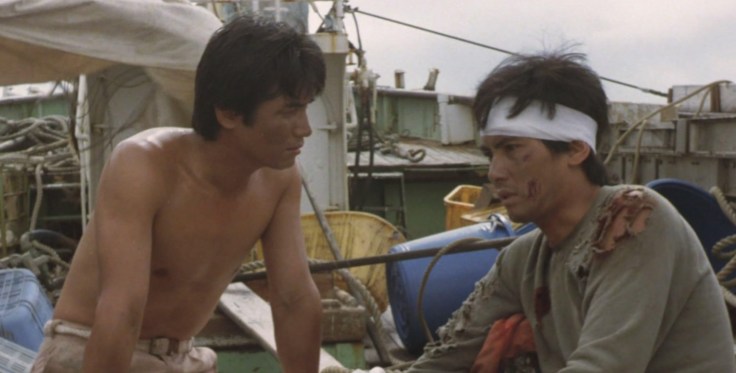
Three months after an eruption on Daikoku Island; the fishing vessel Yahata Maru goes missing. A news reporter discovers the vessel, and is attacked by a giant Sea Louse, only to be saved by the only surviving member of the crew. Once back on the mainland however, he is confined to a police hospital, and his story is kept under wraps. The reason: because he saw another monster, one not seen in 30 years!
Released in 1984, and directed by Koji Hashimoto; The Return of Godzilla is the 16th film in the Godzilla series, and the first in the Heisei era. The film stars Ken Tanaka, Keiju Kobayashi, Yasuko Sawaguchi, Yôsuke Natsuki, Shin Takuma, and Tetsuya Takeda, as well as a guest appearance from Hiroshi Koizumi. The film also features Kenpachiro Satsuma in his first of seven movie appearance as Godzilla. In 1985, the film was heavily re-edited for an American release; and renamed Godzilla 1985. Originally planned to be made into a comedy featuring Leslie Nielsen, and then later Lorne Green; this vision was dropped once Raymond Burr was cast, reprising his role from the 1956 Godzilla, King of the Monsters! The reason for this change of mind, was that Burr quite correctly informed the American distributer that ‘Godzilla was no laughing matter!’
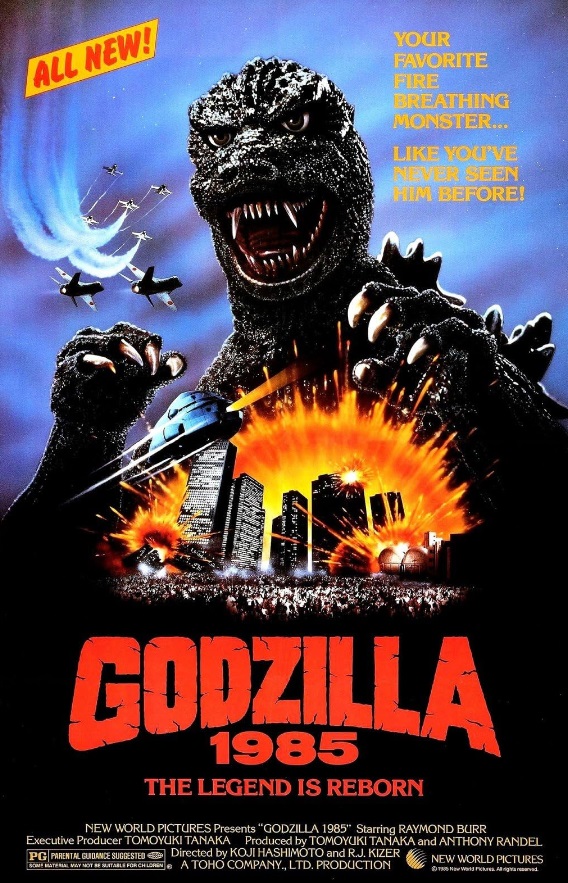
The Return of Godzilla is one of the series most unique entries, but can also be one of it’s more confusing entries, if watched in isolation without any prior knowledge to it’s production. The first time I saw anything of it back in 1999, I couldn’t understand why Godzilla was going on the rampage, nor was being attacked by the military, given how in the 60’s and 70’s, he was a hero. This then got weirder, as the film was made in the 80’s, but kept referencing how Godzilla had not been seen in 30 years; and it made me wonder how it had been 30 years since 1975, if it’s now 1984? So, to reduce confusion, here’s a little backstory…
The Return of Godzilla ignores any of the movies before it except the original, acting as a direct sequel of sorts to that film, and in turn focusses on Godzilla once again being a threat to humanity, due to their increased desire to build bigger nuclear weapons. So, all events from films produced since 1954 have no effect on the story, as they didn’t happen. Japan has moved on from those events 30 years ago, but some characters still remember it. What they don’t remember includes, but is not limited to how Cockroaches once tried to take over the world by building a theme park, the frighteningly high number of Alien Invasions during the 60’s and 70’s, and those weird dreams that kid was having about being friends with the Son of Godzilla. It is of course the 1980’s, which means it is still during the Cold War, and the film does highlight these tensions; and successfully uses them to bring Godzilla out of a nine year hiatus.

But while Cockroaches may not have come, Giant Sea Louses have, with the Sea Louse scene being easily one of the creepiest moments ever in the entire series. It’s so beautifully shot, and can be really chilling, almost like watching Island of Terror for the first time all over again.

It is one of the most unique entries in the series; as though whilst it is the start of a new series of monster films, the film doesn’t follow any templates pre-set by earlier entries, thus allowing the new filmmakers the opportunity to make something a little bit more original. And they succeed in the originality factor, due to several reasons. Firstly Godzilla has been injected with new and more modern (for the time) special effects. The monster is still largely performed through the use of a suit; but several close-up shots of the head were done via an animatronic head. In theory this should allow for more emotion and movement in Godzilla; but sadly, and rather frequently, it looks more like the puppeteer’s vain attempt to audition for the part of Roland Rat.

OK, so the head is largely a bust (joke possibly intended); but the film does feature one of those real rarities in a Godzilla film, that of positioning the camera’s at ground level, really heightening a sense of realism, allowing the audiences to feel more like they are witnessing the events first hand. It also allows for some really juicy moments where scaled shots of Godzilla’s foot comes down, creating a real sense of size and scale.

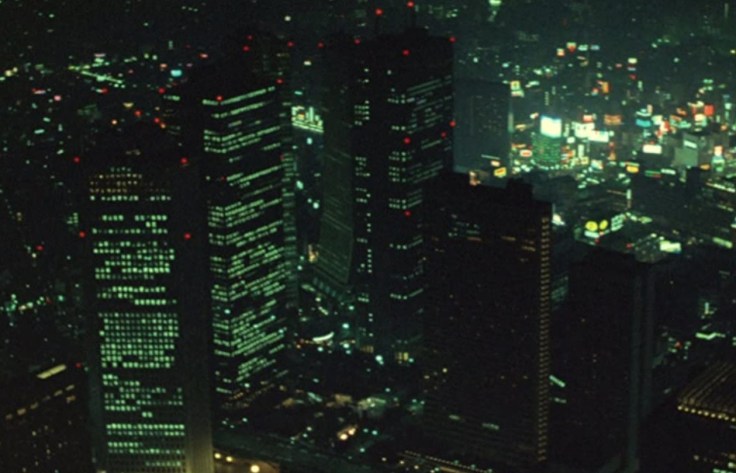
The film’s core cast is neatly small, but is bolstered by quite a few more, and the film really tries to focus both on the scientific side, and political side of the situation, to come up with a positive solution. It is for all intents and purposes, the Shin Godzilla of it’s time, and tries to be as modern as possible in it’s approach. Plus, it features a lot of wonderful panoramic shots of a modern, near state of the art Japan too, particularly in it’s beautiful cities, as well as some shots of it’s countryside too.
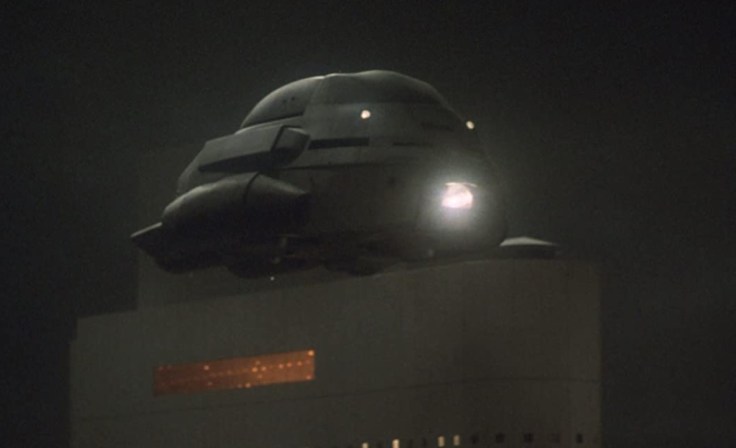
The dark approach to Godzilla’s character meanwhile is constantly on show, as the filmmakers try to make him really terrifying once more. His merciless attack on Japan is diluted a little thanks to his bright friendly animatronic eyes, not like the pure white pupils from GMK. But, he is attacking without mercy, and destroys the city like it’s a game, the easiest game anyone can ever play, thanks to his un-natural abilities. This focussed approach can be seen in full view, when he effortlessly pushes over a skyscraper, to crush the Super-X (a flying fortress the Japanese Government have been hiding in the basement all these years apparently)!
But the real standout to me of this film’s uniqueness, is in it’s soundtrack. Composed by Reijirô Koroku, the film doesn’t use any piece from any film before it, and as far as I can tell, not been used since either. But despite it’s lack of re-usability, this soundtrack stands out more than most, possibly because it has only been used once. The soundtrack is as distinctive as the whole film, and therefore, stands gloriously above all the rest. The military march, and the Super-X theme’s in particular stand out to me, as I have found myself simply remembering them out of the blue, when I have not even been thinking about them. The march Itself is a rather glorious march, which features a little bit of tension, with some sweeter harmonious bits too, but all on a rather grand scale, as if this is what the real JSDF uses for their own personal anthem!
But whilst the military uses an almost epic grand piece of music for military manoeuvres, the ending is so sad and sombre. The last couple of pieces before the end credits have a real sad feeling to them. Surely if the idea is for Godzilla to be defeated, then you’d expect something more jovial. However, the film decides to be as tragic as the original film, with these incredibly sad pieces of music. It’s almost like they were trying to convey the words of Ishirô Honda himself:
“Monsters are tragic beings. They are born too tall, too strong, too heavy. They are not evil by choice. That is their tragedy.”
The Return of Godzilla, is one of the standout entries in the entire series. For reasons both good and bad, you can’t help but see how more distinctive it is to other films in the series. Even if you think it’s a bad one, you can’t say it’s like all the rest, because it simply isn’t. It brings Godzilla back to a more modern world, by taking him back to his roots, as a meaning, an allegory, or metaphor for the nuclear age, and it’s destructive capabilities. But by allowing newer filmmakers the chance to make something more to the vision they see for Godzilla, it means we see a new side to what the series can be, and what it’s still capable of becoming. Something truly special and unique, per entry, no matter how many decades it takes to reach them. Something that can be heightened that little more, given how similar, this film is to something that was released 32 years later. It is in many respects, the Shin Godzilla of it’s time!
 Things I Like
Leave a comment