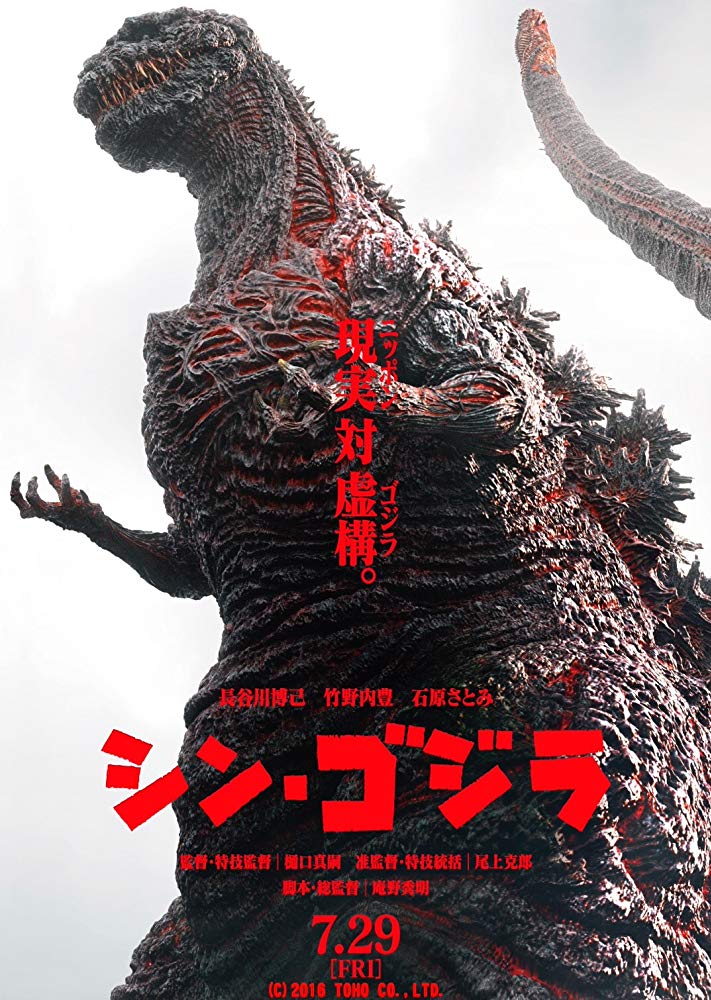
What is initially believed to be an unseen undersea volcanic eruption, turns into something far more terrifying, as a large unidentified creature suddenly crawls it’s way onto land. After just a few hours the creature returns to the sea. The Japanese government quickly put a task force together to try and work out what this new creature is, and how to deal with in case it returns. Sure enough, it does, but it has more than doubled in size!
Released in 2016, and directed by Hideaki Anno, and Shinji Higuchi; Shin Godzilla is a giant monster movie, and the 31st film in the Godzilla film series. The film stars Hiroki Hasegawa, Satomi Ishihara, Yutaka Takenouchi, Mikako Ichikawa, and Ren Ôsugi, with Satoru Matsuo, Akira Emoto, Kimiko Yo, Sei Hiraizumi, Shin’ya Tsukamoto, Kengo Kôra, Ikuji Nakamura, Tetsu Watanabe, Ken’ichi Yajima, and Jun Kunimura in supporting roles. Shin Godzilla was the first Japanese Godzilla film to be made (excluding his appearance in Takashi Yamazaki‘s Always: Sunset on Third Street 2) since Godzilla: Final Wars released in 2004, and the first film of the Reiwa Era. Interesting little tit-bit (that I have only just discovered), Shinji Higuchi had previous experience with the Godzilla series, having worked on The Return of Godzilla as an assistant modeler.

Shin Godzilla is quite possibly the most modern Monster Movie ever, or even possibly the most that’s ever achievable. It can quite comfortably and convincingly achieve this title, by just a quick renaming. Most Godzilla films, are usually titled as follows: Godzilla vs. (insert monster name here). A quick scan through the series titles has led me to find 14 films (in a series of 38) using this title format. So if we were to change Shin’s title, we could describe the film like this: Godzilla vs. Red Tape.

In a nutshell, that’s what this film is. It’s about a giant monster coming ashore, with authorities largely passing the buck to decide whose responsibilty this whole thing falls under, and then asking them to come up with an appropriate response. That’s why the monster’s initial attack is completely unhindered for over 2 hours, before then returning to the sea. Sure, the government finally decides to do something about it, but again it largely comes down to a mere show of available force, rather than a full blown demonstration.

After Godzilla’s initial attack and appearance, they do get their act together, and are in a better position to respond the second time around, leading to an impressive military attack half-way through the film. This is however hindered by the biggest problem they face. Now, it’s no secret that the military has been rather weak to the power and invulnerability of Godzilla over his 70+ career. In every film (except at least one American film…in 1998) the military takes action, but all their weapons are useless, as they barely cause a scratch to Godzilla’s skin (except for one film…in 1998). So it’s no surprise here then that military weapons are also useless to this new threat. But that’s not the only problem.
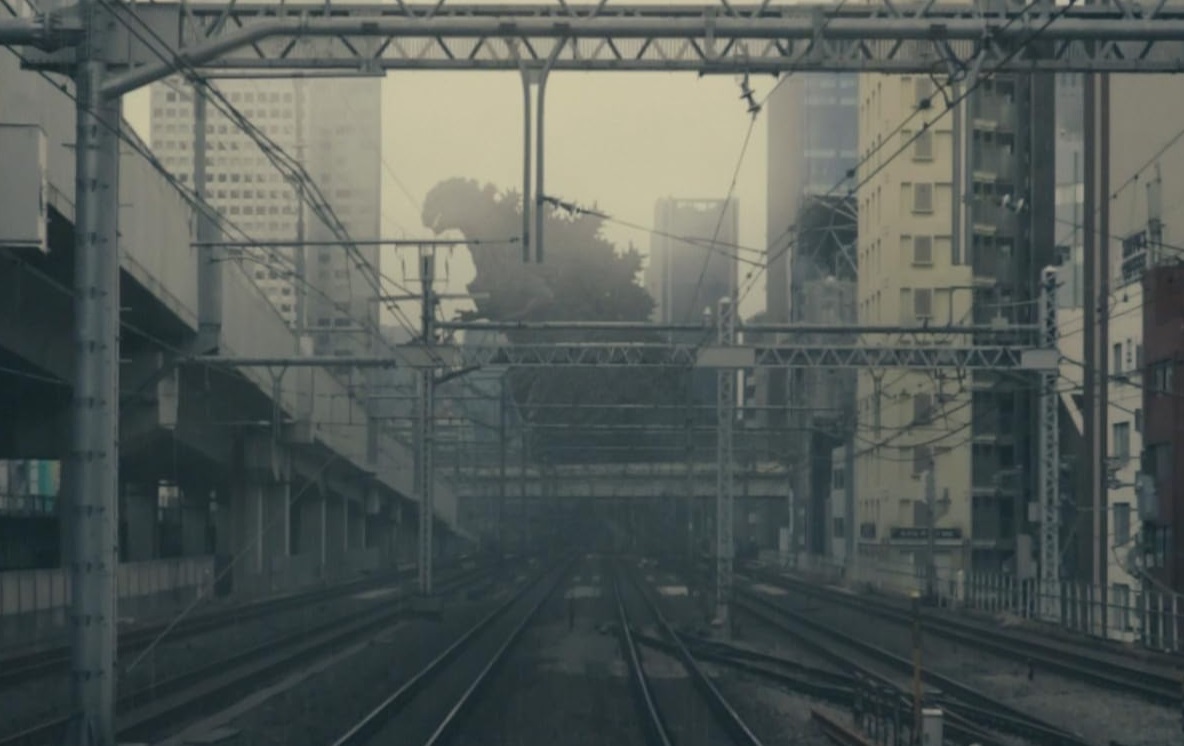
The film drew inspiration from the 2011 Tōhoku Earthquake and Tsunami, and Fukushima Nuclear Accident, and therefore chooses to represent Godzilla in an all new awe-inspiring way. Godzilla has always been depicted as a force of nature. Mother Nature‘s own ultimate weapon, to strike back against humanity destroying the Earth with it’s nuclear arsenal. Here however, he is depicted as a natural disaster. So again, he’s a force of nature, highlighting how damaging and powerful nature can still be, but here’s the kicker: he’s a natural disaster, that can evolve. A natural disaster that looks bad to begin with, but can get worse…and even worser still!
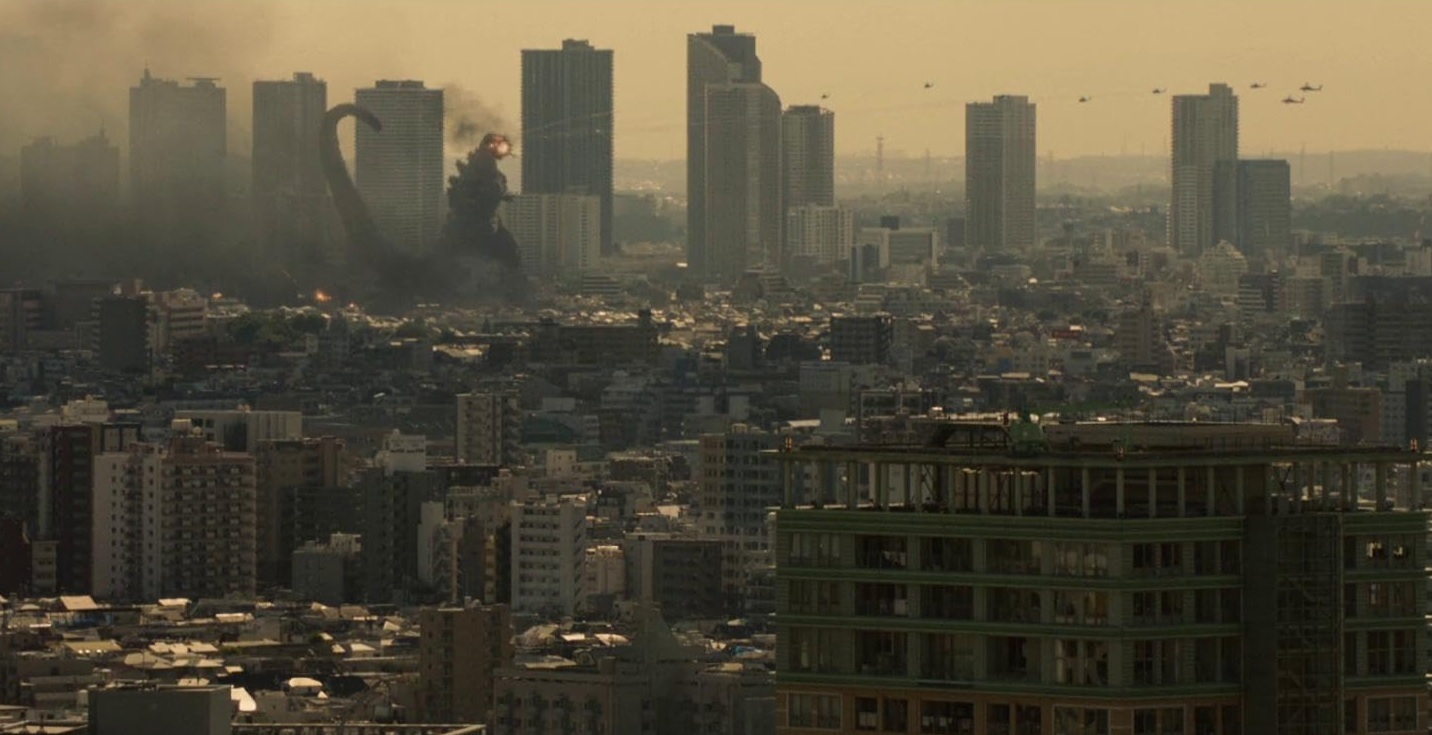
Imagine a Tsunami, but one that suddenly can grow legs and walk further inland, and then evolves into a Volcano, raining molten fire on the land, and then somehow able to generate Lightning storms! It may sound ridiculous (although I do find it somewhat surprising that no film along simillar lines was ever produced by any American studio during the trend of Disaster Movies between 1990 and 2010), but that’s what the imagination is for, because we can’t see it ourselves actually taking place. Now Godzilla in this film is nowhere near as ridiculous as that, but he is still an evolving natural disaster, and one that can do it within the blink of an eye.
We see it early on when he is in the water, but then suddenly comes ashore, and then after skimming along on his belly, stands upright. He then doubles in size, gains the use of his iconic atomic deathray, and then finds other ways of using it. Such as when bombs successfully damage him in the back, so he starts shooting rays out of his back, to protect himself. He is not just evolving then, he is adapting and responding to threats, allowing him to become more and more invulnerable,and cause even more damage than he did before. Therefore, this is the military’s big problem with dealing with the situation. The enemy is not just invulnerable, it can adapt to any situation, and any weapon thrown at it. Which then leads to the final evolution.

Shin Godzills is an experimentation piece, as on the one hand it tries to convey a more modern approach to such a disaster, whilst possibly highlighting the real-life government and international approach to disasters of this kind. But at the same time,it’s something of a tribute, and love story to the appreciation of monster movies, and the Godzilla series a whole. Hideaki Anno originally turned down the opportunity to direct a new Godzilla film when he was originally asked, due to a lack of confidence, stating:
“I refused [the offer] since I didn’t have confidence that I could exceed the first film or come close to equaling it. But I thought that if I were to come close even a little, I would have to do the same thing [as the first film]”

One of the highlights to this approach isn’t really seen, but rather heard. Composed by Shirō Sagisu, the soundtrack features a cool mix of pieces. Some of which were produced for the film, whilst others came from other sources.
The film’s main themes (like Persecution of the Masses) are rather harrowing pieces, highlighting the depressing seriousness of the situation, and the great destruction that unfolds. Then there are pieces like Decisive Battle, which originate from the Anno’s Neon Genesis Evangelion series, which are used to great effect to ramp up tension, in scenes where it feels like they are most needed (or look like they aren’t).
But the music that is most apparent in this film, are pieces from the original films, such as the originl 1954 Godzilla, Ghidorah, The Three-Headed Monster, and Terror Of Mechagodzilla; as well as a few other non-Godzilla films too like Battle in Outer Space. These pieces are a wonderful addition to the film, which show an essence of appreciation to those classics, and the series as a whole, plus are wonderful insertions for fans to get excited about when they see the film for the first time.
Shin Godzilla is a Fantastic Film. It took a new approach to the series, focussing on trying to make one great film, rather than ideally set-up a new series. And whilst it’s still a little disappointing that no sequel came about, that doesn’t detract anything from this film’s overall quality. It depicts a modern take and approach to the sudden appearance of a monster like Godzilla from the authorities, whilst also highlighting the very real threat from a natural disaster. Add to that it’s soundtrack, which mixes exciting classic pieces, with harrowing new ones, and altogether you have one monumental monster movie. One that I personally consider, to be the Best of the Best (and my Number 1 Favourite Movie in the whole world)!
 Things I Like
Leave a comment