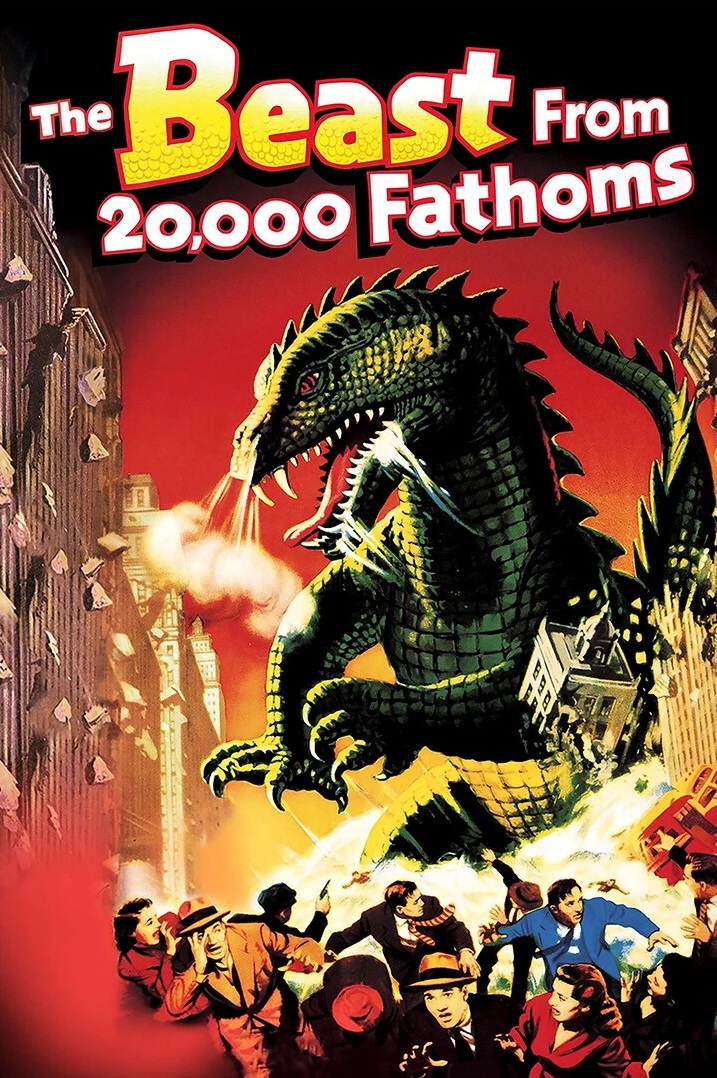
In the far north of the Arctic Circle, a nuclear bomb test is conducted as part of an operation with an un-imaginative name (‘Operation Experiment’). After the test, a couple of scientists venture out into the test area to gather readings, but during this time, they both see a huge monster. One of the two scientists perishes when the creature causes an avalanche that buries him. Upon returning to New York, the remaining scientist tells everyone what he saw, but they just don’t believe him!
Released in 1953, and directed by Eugène Lourié; The Beast from 20,000 Fathoms is a monster movie, partly based on the 1951 short story of the same name (but later reprinted as ‘The Fog Horn‘) by Fahrenheit 451 author Ray Bradbury. The film stars Paul Hubschmid, Paula Raymond, Cecil Kellaway, and Kenneth Tobey, with Donald Woods, Lee Van Cleef, Steve Brodie, Ross Elliott, and Jack Pennick in supporting roles. It is also the first film that special effects director Ray Harryhausen was given full control over the special effects, which in turn launched his legacy as one of the most influential figures in both special effects and animation. Watching The Beast from 20,000 Fathoms is also one of my earliest memories, as it was frequently shown in the mornings on Channel 4; before the morning Godzilla movie one summer (I was about four years old at the time).
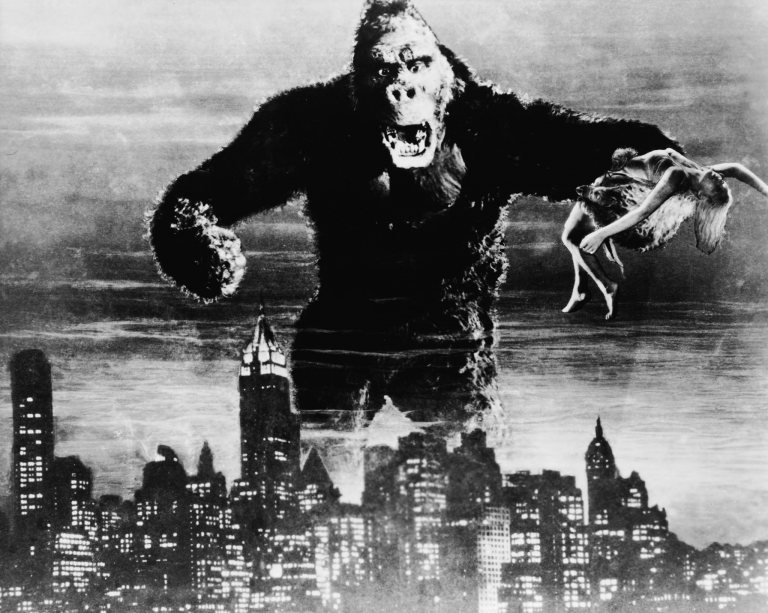
The Beast from 20,000 Fathoms is one of the most significant movies in the monster movie genre. Whilst the genre was launched on the backs of earlier films like The Lost World, and of course the original King Kong; The Beast from 20,000 Fathoms very much became the catalyst for every film produced since. It achieved this in several ways, but the two main immediate ones are:
- It’s considered to be the first movie featuring a monster unleashed by an atomic bomb, and
- It’s generally considered to be the first film, where the monster goes to a city of it’s own free will.
Now both cases state that its considered to be, because it may not be the case that it was the first film to do so, but it could still be argued that due to the film’s success that it was the first more well known film to do so.
Why are these two statements important you might be asking? Well, in the case of the second one, virtually (if not) every monster movie released before The Beast from 20,000 Fathoms involved the monsters being discovered on lost worlds (like in both The Lost World and original King Kong), and then being brought to the mainland against their will. In the case of The Beast from 20,000 Fathoms however, the creature isn’t brought to New York City, it instead goes there by it’s own desire.
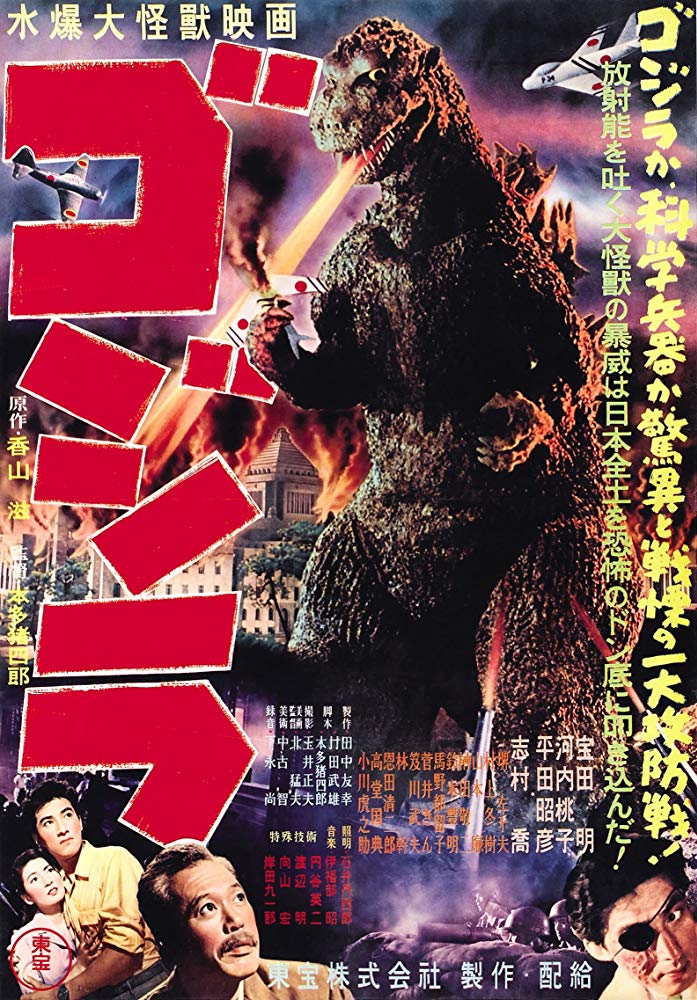
As for the first point; The Beast from 20,000 Fathoms depicts a monster, whose arrival and sudden appearance is the direct result of a nuclear weapon. Having been encased in ice in the Arctic Circle for millions of years, the bomb test has awoken it, and it’s now on the loose. Why is this an important step? Well, according to many restrospective sources, this concept was heavily influential on a group of Japanese filmakers, who released their own monster film: Godzilla, a little over a year later. It is very possible then, that had this film not been made, then the monster movie/kaiju genre, may look very different today, and famous names within it (like Godzilla and Gamera for instance), may have never been spoken.
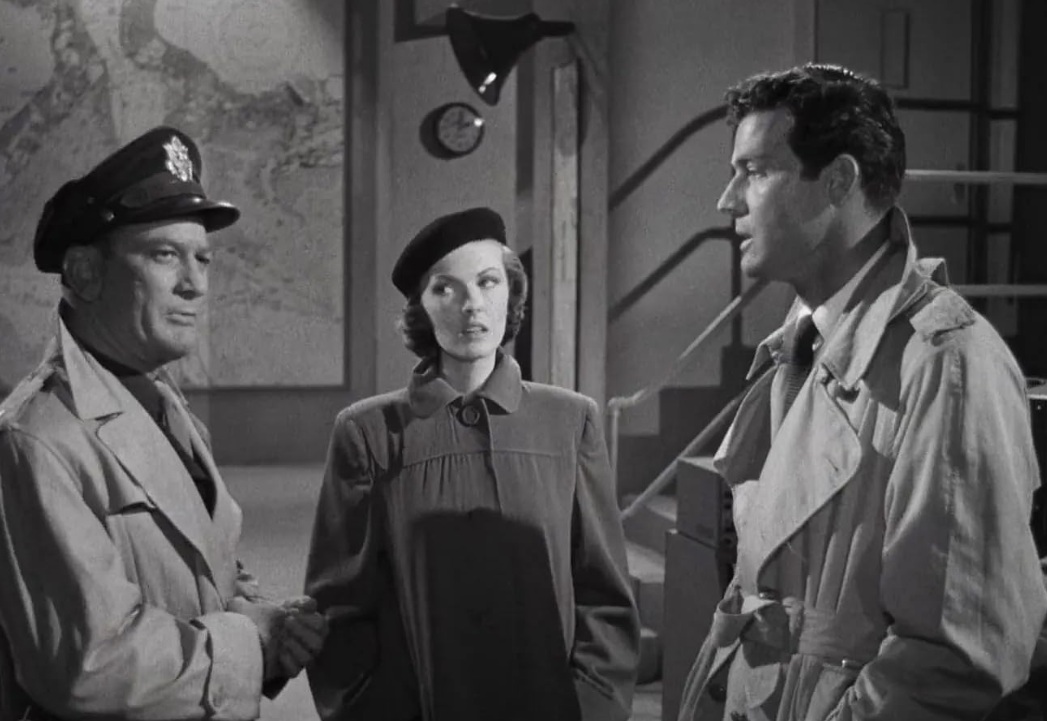
The Beast from 20,000 Fathoms is a really simple film to watch. It’s not mega complicated in the science-y bits, as it tries hard to remain as easy to watch as possible. One way it achieves this, is in it’s build-up. Even though we as an audience have seen the monster, those who haven’t find the story hard to believe. If we were in the same situation, we too would find it a hard story to believe as well. In that respect it’s a film where the situation is very believable on a human level, which in turn helps make the film as realistic as possible.
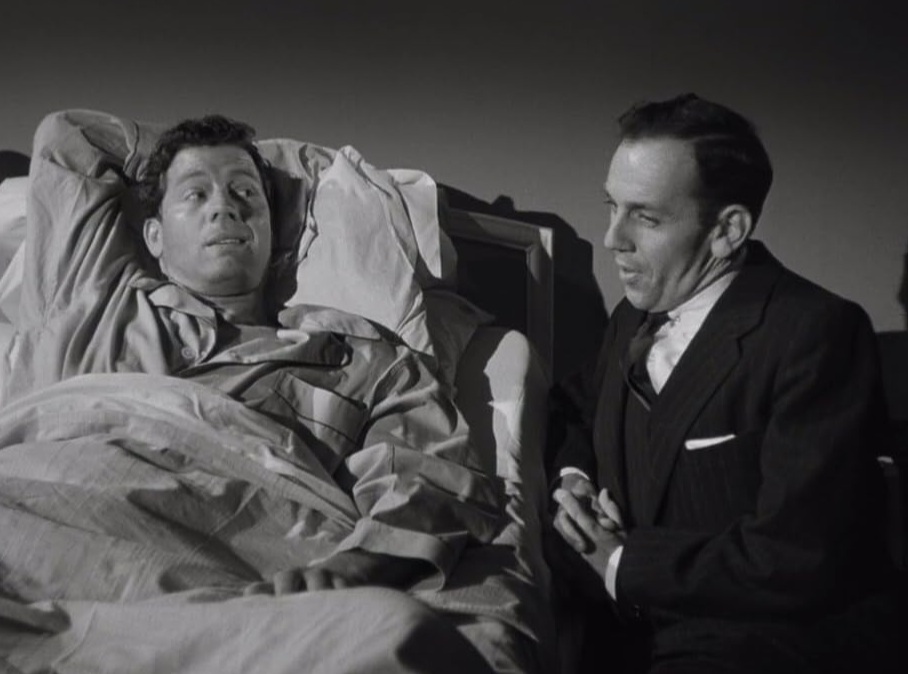
This approach in build-up continues for quite a while. Rather than jumping straight to the point where everyone acknowledges the existence of the creature early on, the characters here, have to really work hard to make people believe the situation, and in turn this can cause other characters to question their sanity; no matter how hard the heroes (Hubschmid and Raymond) try to warn people of the dangers the creature could posses. It’s very simillar in narrative to the first two Jaws films. In the first film, Chief Brody (Roy Scheider) is told of the Shark attack, but is told to keep quiet about it, until a major incident occurs which cause the town to acknowledge the threat. Then in the second film, due to the trauma of the events of the first film, the locals question his sanity, despite him seeing the simillarities.
This build-up doesn’t end, until the scientist character (Kellaway) finally sees it. Up until this point, the Rhedosaurus makes only casual appearances, which helps with the sanity angle in the heroes motives, but once it’s existence is verified, there is now more time for the monster to be a more integral occurence (much like Jaws).
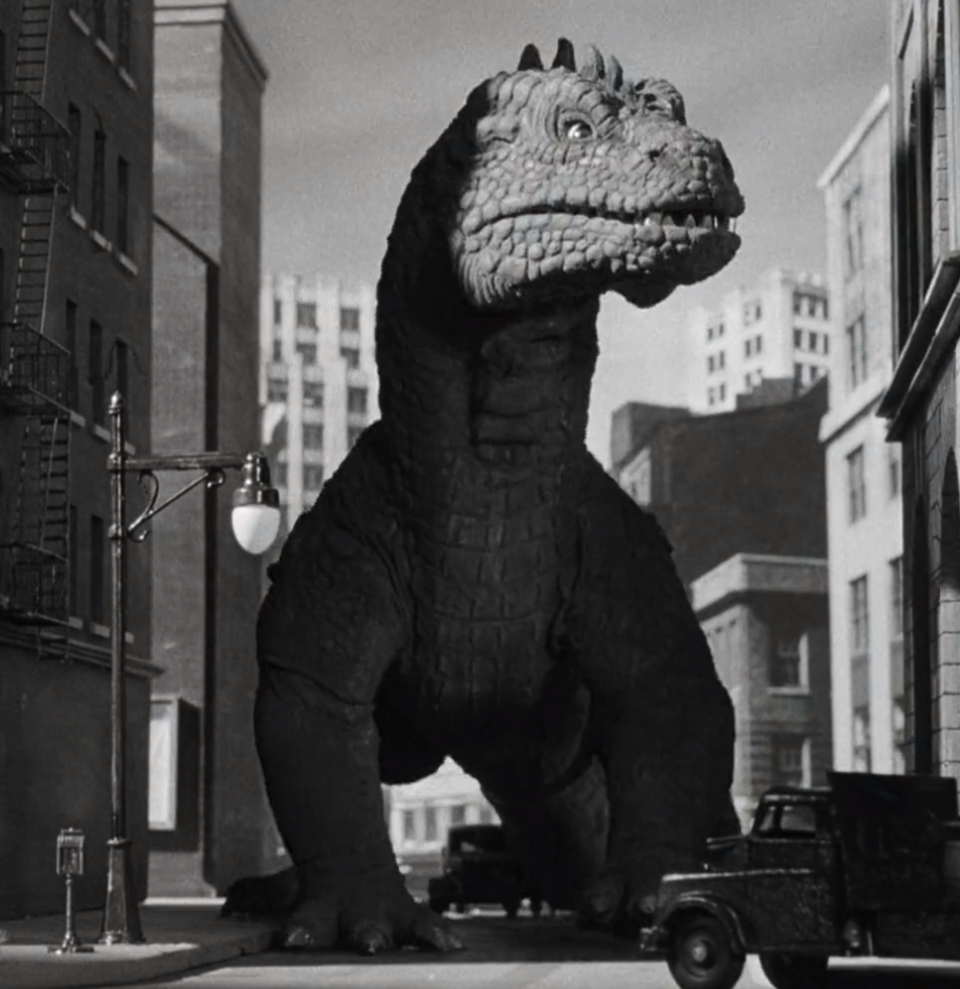
What is also quite effective, is the creature’s size. Many monster movies feature colossal creatures, which could be seen from almost anywhere in the city it’s attatcking. The Rhedosaurus meanwhile is a lot smaller by comparison. But this allows the terror of the creature to be a lot more localized (much like The Host). Therefore only those in the local vicinity can actually respond to the threat, whilst people on the far side of New York have no idea it exists, until it’s reported (although this doesn’t stop some people from casually walking away from the monster in the near distance, where-as everyone else in the foreground is actively running away from it). This is means the monster is an even larger threat on a personal level, as due to it’s smaller size, it would get more satisfaction from consuming people, as it could be more selective as to who it eats, and still get a sense of filling up. In comparison; if a monster as big as Godzilla were to eat the odd person, the satisfaction would be like a mere crumb of a McNugget!
The Beast from 20,000 Fathoms is a landmark film in the monster movie genre, and easily one of the best independant films of the genre too (in that it’s not directly associated with any particular series). The success of this film led to the creation of films like Godzilla, whilst also changing the direction of many monster movies to come, choosing to focus on the threat approaching, rather than being brought to the location. But when you look past these points, you really get to see what a terrific film this is by it’s own merits. It features a very human story in the realms of belief and reality, featuring two warring viewpoints. This then leads to the Rhedosaurus’s attack, which thanks to it’s choice of scale, creates a real sense of horror, as instead of being something so big you can easily run away from; here you can only react, when you actually see it, which could just be around the corner from where you are standing right now!
Can I also say how nice it is to see a monster dragging it’s tail across the floor!


Leave a Reply